
Ring Size Conversion Chart
Ring sizes use different systems around the world — numbers in the US, letters in the UK and Australia, circumference in millimetres in Europe and numbers again (on a different scale) in Japan. Enter any size or measurement and the converter shows the equivalents in every system, plus the inside diameter and circumference, so you can buy with confidence from anywhere.
- Free to use
- No sign-up
- Runs in your browser
Ring size converter
Ring Sizer & Conversion Pack
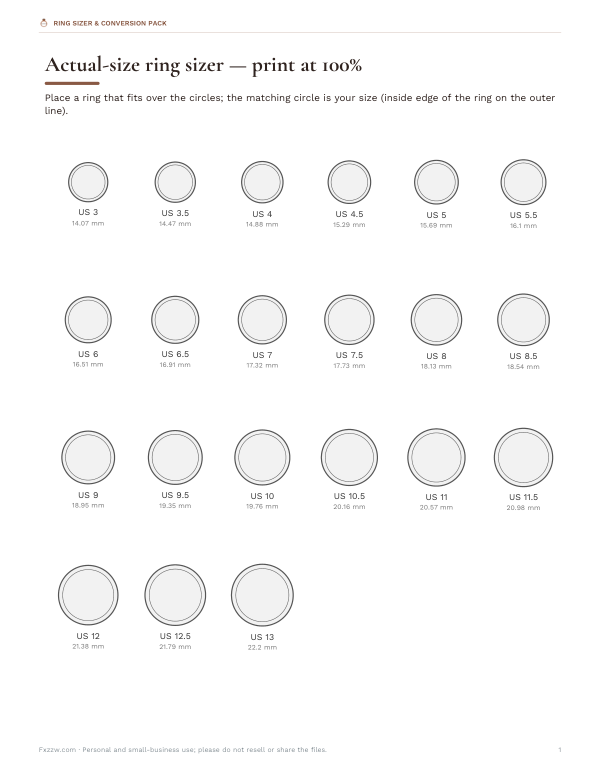
Printable actual-size ring sizer (US 3–13 circles), a paper ring size strip, an international ring size conversion chart and a gift ring size worksheet.
- Ring sizer (PDF)
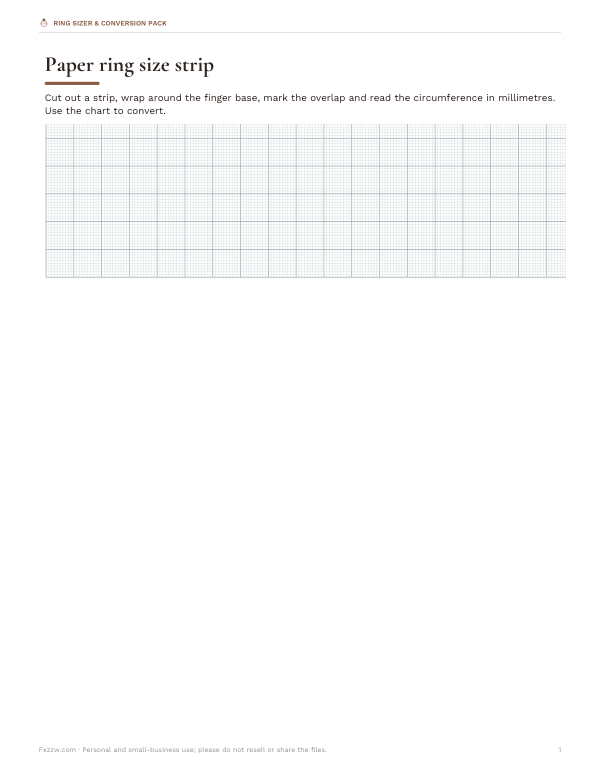
- Ring size strip (PDF)
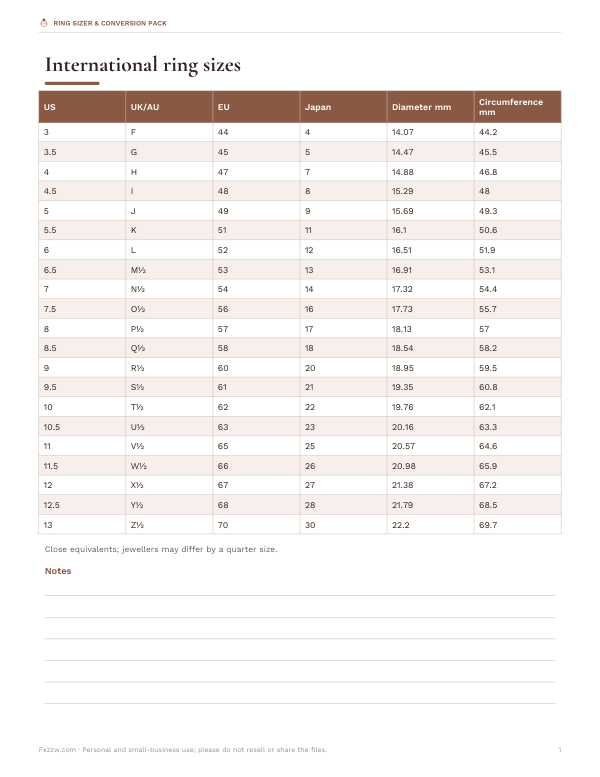
- Conversion chart (PDF/XLSX)
- Gift worksheet (DOCX/PDF)
Formats: PDF, XLSX, DOCX. Instant download after payment (link valid 72 hours, up to 5 downloads). AI-assisted: the templates were drafted with AI help and reviewed and laid out before publishing.
$3.00 USD, one-time 4 files · about $0.75 each
- Instant download
- 7-day refund
- Secure checkout by Stripe
7-day money-back guarantee. Full refund within 7 days of purchase, even after you download.
Free sample: Gift Ring Size Worksheet (PDF, 51 KB)
Full refund within 7 days — see the refund policy and license.
Free printables
Single sheets you can print right now, no sign-up. The full pack adds every sheet in one download plus the editable files.
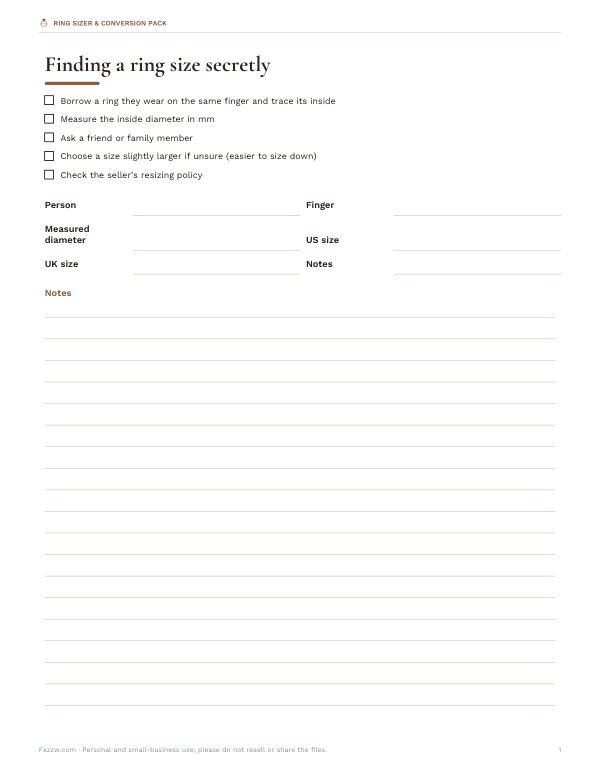 Printable Secret Ring Size Worksheet
How ring size systems work
| System | Based on | Example (same ring) |
|---|---|---|
| US / Canada | Numbers in quarter and half sizes; each full size ≈ 0.81 mm more diameter | 7 |
| UK / Australia / Ireland | Letters A–Z with half sizes | N½ |
| EU / ISO 8653 | Inside circumference in millimetres | 54 |
| Japan | Numbers on a scale roughly equal to circumference − 40 mm | 14 |
| Diameter | Inside diameter in millimetres | 17.3 mm |
Because each system uses a different step size, conversions are close equivalents rather than exact matches. When in doubt, go by the inside diameter or circumference in millimetres.
US ring size conversion chart
| US | UK | EU | Diameter (mm) | Circumference (mm) |
|---|---|---|---|---|
| 4 | H | 47 | 14.9 | 46.8 |
| 5 | J | 49 | 15.7 | 49.3 |
| 6 | L | 52 | 16.5 | 51.9 |
| 7 | N½ | 54 | 17.3 | 54.4 |
| 8 | P½ | 57 | 18.1 | 57.0 |
| 9 | R½ | 60 | 18.9 | 59.5 |
| 10 | T½ | 62 | 19.8 | 62.1 |
| 11 | V½ | 65 | 20.6 | 64.6 |
| 12 | X½ | 67 | 21.4 | 67.2 |
How to measure your ring size at home
- Existing ring: measure the inside diameter of a ring that fits the right finger with a ruler or calipers, and enter it in millimetres.
- Paper strip: wrap a thin strip of paper around the base of the finger, mark where it overlaps, and measure the length in millimetres — that is the circumference.
- Printable sizer: print the ring sizer from the pack at 100% and place a ring over the circles.
- Measure at the end of the day, when fingers are largest, and at room temperature.
- Make sure the ring or strip can slide over the knuckle.
Fit tips
- Fingers swell in heat and shrink in cold; measure at a comfortable temperature.
- Wide bands (6 mm and over) fit tighter — go up a quarter to a half size.
- If your knuckle is large, choose a size that just slides over it; sizing beads can stop the ring spinning.
- Your dominant hand is usually slightly larger.
- Pregnancy, weight changes and age can change ring size.
Worked example
A buyer in the UK knows they wear an N½ and wants a ring from a US shop. The converter shows N½ is about 54.7 mm circumference and 17.4 mm diameter — US 7 (EU 54–55). Because the ring is a wide 7 mm band, they choose US 7¼.
Ring sizes by finger and gender (typical)
| Finger | Typical women’s range (US) | Typical men’s range (US) |
|---|---|---|
| Thumb | 6–9 | 8–12 |
| Index | 5–8 | 8–11 |
| Middle | 5½–8½ | 8½–11½ |
| Ring | 5–7½ | 8–11 |
| Little | 3½–6 | 6–9 |
These ranges are broad and only a starting point — measure the actual finger. The right hand is often slightly larger than the left.
Ring size and metal type
Comfort-fit bands have a rounded inside and can feel looser than standard flat-inside bands of the same size, so some people choose a quarter size smaller. Heavy or chunky rings can feel tighter. Tungsten, ceramic and titanium rings usually cannot be resized, so measuring carefully matters most for those metals. Stackable rings worn together behave like a single wide band and may need half a size larger.
Printable ring sizer tips
Printable sizers only work if they print at exactly the right scale. Set the print dialog to 100% or “Actual size”, then measure the reference line on the printout with a ruler before using it. Place a ring that fits over the circles so the inside edge of the ring lines up with the outside of a circle; if it falls between two circles, choose the larger.
Reading jewellers’ size labels
Online listings may say “size 7”, “N½”, “54” or “17.3 mm”. When a listing does not say which system it uses, check the seller’s location and size chart. European shops often sell by circumference, while some Asian retailers use the Japanese or Chinese scale. The converter table covers the common equivalents side by side.
Measuring children and for gifts
Children’s ring sizes are usually US 1–5. For a surprise gift, borrow a ring the person already wears on the intended finger and measure its inside diameter, or ask a friend. If you have to guess, choose slightly larger — it is easier to size a ring down than up — and check that the seller offers free resizing or exchanges.
Resizing rings
Many plain metal bands can be resized by a jeweller by one or two sizes. Rings set with stones all the way around (eternity bands), tension settings, some titanium, tungsten and ceramic rings, and rings with engraving around the band can be difficult or impossible to resize. Check the seller’s resizing and exchange policy before buying.
Privacy
The converter runs in your browser.
Frequently asked questions
What is a size 7 ring in UK?
About N½.
What is a US 7 in EU size?
About 54 (54.4 mm circumference).
How do I measure ring size at home?
Measure the inside diameter of a ring that fits, or the circumference of your finger with a paper strip.
Should I size up for a wide band?
Often by a quarter to a half size for bands 6 mm or wider.
What is the most common women’s ring size?
In the US, sizes around 6–7 are common; always measure rather than guess.
How much bigger is each US size?
About 0.8 mm in diameter or 2.55 mm in circumference.
What is a half size?
A size halfway between two whole sizes, about 0.4 mm in diameter.
Do rings fit differently in winter?
Yes, fingers shrink in cold and swell in heat.
Is my data stored?
No, it runs in your browser.